rgz

readergirlz is a literacy and social media project for teens, awarded the National Book Foundation's Innovations in Reading Prize. The rgz blog serves as a depot for news and YA reviews from industry professionals and teens. As volunteers return full force to their own YA writing, the organization continues to hold one initiative a year to impact teen literacy. All are welcome to "like" us on Facebook!

Showing posts with label recommended reads. Show all posts

Tuesday, April 30, 2013

Teens Wanna Know: Otherworldly YA Books

Looking for an awesome YA book that will take you out of this world? Love sci-fi/fantasy series? Check out my guest post at Teens Wanna Know! 

I've recommended five fantastic stories by Christopher Golden (Prowlers), Thomas E. Sniegoski (Fallen), Scott Westerfeld (Uglies), Justine Larbalestier (How to Ditch Your Fairy), and Holly Black (The Curse Workers). These books include angels, shapeshifters, surgeries, good luck, and bad luck, among other things. 

If you haven't read them yet, you should. If you have read them, let me know which one you liked the best.

Check out my Otherworldly YA post at Teens Wanna Know and leave a comment!  

Thursday, November 25, 2010

November Feature: The River by Mary Jane Beaufrand

Are you ready to wade across The River? This intriguing novel by Mary Jane Beaufrand is one of this month's recommended titles. Take a peek:

Veronica Severance feels cut off from the world. Forced to move from the city to rural Oregon with her parents, she is haunted by loneliness and by the chilling sounds of the Santiam, the river that runs through her backyard.

Through the fog of isolation, Ronnie finds herself becoming close with Karen, a young girl who she babysits. But when she discovers Karen's body on the banks of the Santiam, the victim of a supposed accident, Ronnie feels compelled to uncover the truth.

As she becomes increasingly obsessed with solving Karen's death, Ronnie is led deeper and deeper into the woods surrounding the river and to the dark secret hidden within its midst.

Mary Jane Beaufrand, the author of The River, shared this deeply personal story with us:

My sister Ann is a breast cancer survivor. She was diagnosed in 2007, has been in remission since 2008. But recently, a full two years being pronounced healthy, she had herself a good freakout.

Here’s the sitch: she wanted to swim laps at the Open Swim Hour at her local high school, and didn’t want to be seen changing in the girls’ locker room. The problem? The scars from her bilateral mastectomy. Don’t get me wrong—she had reconstructive surgery, so from five paces away she looks perfectly normal. But that scrawny hairline scar still stretches from one side of her ribcage to the other. Uber-dramatic up close. Like in a locker room.

“Girls that age just don’t understand,” she told me. “They still think you can be perfect.”

I nodded and made noises like I agreed, but five minutes after I left her, realized that she was dreading the judgment of teenage girls as much as she dreaded chemo. Huh. Something was definitely off.

I kept going back our conversation when Readergirlz asked me to blog about resilience. Believe me, I’d much rather write about things that invoke a different kind of response, like moose drool. Or donuts. (Or, as my daughter would add, moose drool *on* donuts. She gets a kick out of stuff like that.)

But it seems to me there’s a nugget in my sister’s dread that’s worth exploring. Because I think the issue of teenage judgment—both real and imagined—has more to do with resilience than it would first appear. I’m thinking of my sister’s scars, but I’m also thinking of Spirit Day this past October 20, and the glut of teen suicides in the wake of bullying. When I was listening to NPR last week, a commentator was talking about this subject and mentioned that, while some of the bullied suicides were gay, not all of them were. The common denominator was that they were perceived to be different.

It seems to me that a major component of resilience is tolerance, both in yourself and the people around you. If you’re going through an episode in your life where you have to be strong, it’s important to find someone who, if they can’t identify with what you’re going through, can at least imagine going through it. Those tolerant, understanding buddies? They may not be the ones you think.

In The River, my heroine, Veronica Severance, makes a series of mistakes along those lines. At the beginning of the book, she’s judgmental of the people around her, thinking that since she’s a transplant from the city, she’s better than her neighbors in the country. Ya-huh. You just know attitude can’t continue.
Secondly, she’s drawn to people based on the way they dress and their taste in music. And yes, in real life those things can really endear someone to you, but they don’t go deep enough to tell you about their true character. It’s no accident that, in order to see the truth about the people around her, Veronica has to be submerged in something that’s much more treacherous than it looks on the surface. Surfaces can lie.

So that’s about it. If you’re in need of resilience, I’m with you. Stay strong. Practice tolerance and seek out tolerant buddies. Veronica’s mother would also tell you that comfort food helps, and to be sure to enjoy a donut now and then.
But please, for my sake, hold the moose drool.

- Mary Jane Beaufrand

Now we want to hear from you. What did Veronica learn about truth and treachery? Have you ever heard a secret that you wish you hadn't? If you were in Veronica's shoes, would you have acted the same way she did? Leave your comments below!

Sunday, October 31, 2010

Prowlers by Christopher Golden, recommended by Little Willow


After reading October's spotlighted title, Lips Touch by Laini Taylor, you'll probably want to sink your teeth into another shapeshifter story. Run, don't walk, to get the Prowlers novels by Christopher Golden, which we've named recommended reads this month.


In this thrilling four-book series, a young man named Jack has to face the shapeshifters who killed his best friend. The monsters have the ability to change at any time, which, to me, makes them more frightening and deadly than werewolves who may only change when there's a full moon. In addition to their physical strength, they are also incredibly cunning, and they are usually human in appearance. Instead of being mindless killing machines, they are incredibly layered characters who have all of the wonderful and horrible strengths and weaknesses we do when it comes to those we love or things we stand for or against, making them dynamic adversaries for the good guys.

Golden also takes a cool angle on the classic love triangle: the main character, Jack, falls for Molly, who was his best friend's girlfriend. You know, his best friend, Artie, who was killed by the Prowlers. Artie's now a ghost, but he doesn't want Jack to tell anyone that he can see him. Plus Jack's got this awesome older sister, Courtney, and then there's Bill, who...well, you have to read the books to find out!

This series should be read in order.
Prowlers
Laws of Nature
Predator and Prey
Wild Things

Read my post about Prowlers at my blog, Bildungsroman.

Learn more about the series at the author's website.

Pssst... If you're planning to watch The Walking Dead on AMC tonight, check out this St. Martin's interview with authors whose short stories appear in the zombie anthology The New Dead and see what they think about the new TV show!

Have a happy Halloween, readergirlz. Please be safe!

Monday, October 25, 2010

Guest Post: Jamie S. Rich

This month's theme of Love naturally led us to 12 Reasons Why I Love Her by Joëlle Jones and Jamie S. Rich. This graphic novel was named a recommended read in the October 2010 issue, and I recommend it to people whether or not they are comic fans, because the story transcends the format and will snag the hearts of romantics as well as graphic novel enthusiasts. Jamie was kind enough to tell me about the origins of the book:

It all seems so simple now, I can barely believe it. It was a Saturday night, I think in 2003, and I was bored and trying to think of a side project to write during breaks from my second novel, The Everlasting. I am a big fan of good romantic movies, particularly Hollywood classics with Cary Grant or the Katharine Hepburn and Spencer Tracy pairings, and I started to think about the modern equivalent. If it were possible to write a movie like The Apartment or Two for the Road now, how would I do it? I don’t know if I was conscious of the Two for the Road connection at that very moment, but Stanley Donen’s 1966 masterpiece would end up being a real inspiration for what I was about to cook up. In it, Audrey Hepburn and Albert Finney play a married couple who are heading for the rocks, and by criss-crossing several narrative timelines at once, Donen lets us compare and contrast and see how they got from very young love to very old love by drawing ingenious parallels between the jumbled stages of their life together.

I began with my two main characters, Gwen and Evan. I don’t generally talk about this much, but the germ for them both was the casting for this imaginary film. At that time, I couldn’t think of a better pair for a movie than Gwyneth Paltrow and Ewan McGregor. I envisioned the opening scene, a tricky intro that at first glance would look like the first time these two had met. Borrowing the title 12 Reasons Why I Love Her from a song by the British band My Life Story, I quickly began to map out twelve more chapters, setting a gameplan for how I would lay this story out. Chronological order would be jettisoned. I’d start with the first date, but I’d end with the real first meeting. There would be big events, but we would maybe see the fall-out from those events before we actually get there. And there would be abstract sections. I’d have one where Gwen would tell jokes, and maybe one about things she liked, and there would have to be a childhood flashback. Given the title, it would all be Evan’s point of view, and each chapter had to have some rationalization for how he knew what he knew if he wasn’t actually a part of it. The idea was that by timing the flow of information, I could simulate the scattered and disjointed experience of a real relationship, chronicle the good and the bad, and chart the uneven ground that an honest love must traverse to stay alive. The outline came quickly, like tuning in a radio signal and twisting the knobs until I had identified all the frequencies.

The movie idea went away pretty fast, as did the casting. The characters, as they are wont to do, took on a life of their own, and I only had a couple of toes in before I knew I wanted this to be a comic book instead. I fired up my scriptwriting program and banged out the prologue. That first draft is exactly what you see in the first pages of the book. It never changed. Only my first novel, Cut My Hair, arrived as so clear a vision, where I knew right from the start what I wanted to happen. With that book, I wrote the first chapter, and then I wrote the last page, and proceeded from there to fill in the rest. 12 Reasons Why I Love Her was pretty much the same.

12 Reasons, then, was always a book that seem buoyed by fate. Everything happened for a reason, everything came together as it was supposed to. Naturally, the biggest event was finding Joëlle Jones and her agreeing to draw it. Our first meeting was in a coffee shop, and the conversation thankfully resembled more of Gwen and Evan’s second first date rather than their first first date. We became fast friends and remain pals and collaborators now some five years later. Her art took the material in all the right places, expanding on what I had envisioned, and making it all look so elegantly simple.

12 Reasons Why I Love Her is one of those fortunate books that keeps finding new readers, that has a life of its own. Different people find different things in its pages, they react in different ways. I commonly ask new fans what they think happens next. Do Gwen and Evan stay together, or is it over? I know my answer, and I know what feeling I wanted the reader to walk away with, but it’s out of my hands now...and in all of yours.

- Jamie S. Rich

Monday, October 18, 2010

Guest Blog: Pat Mora

One of the books recommended by the postergirlz this month is Dizzy in Your Eyes: Poems about Love by Pat Mora, who wanted to share a little something with the readergirlz:

Great to have my book of love poems included in rgz. Great site/great blog. Writing DIZZY IN YOUR EYES, doing a whole book about different kinds of teen love, was a joyful project. Know those Russian nesting dolls? We’re all like that, all our former selves nesting inside.

- Pat Mora

Monday, September 20, 2010

Guest Blog: Lisa Shanahan

One of the books we postergirlz recommended this month is Lisa Shanahan's wonderful novel My Big Birkett, which was published in the USA as The Sweet, Terrible, Glorious Year I Truly, Completely Lost It. (Make sure you look it up both ways when you visit your local bookstore or library!) Lisa recently shared the backstory of this book with us here at readergirlz:

I first began writing my novel The Sweet, Terrible, Glorious Year I Truly, Completely Lost It during a heartbreakingly difficult time in my own family. In the late nineties, my older sister gave birth to triplets, only to be diagnosed days later with cancer. Months after that, my dad was also diagnosed with cancer too. Then followed this extraordinary year, where we had the intense pleasure of watching the triplets who were so little, grow fatter and funnier and more content - saying first words, eating their first solids, taking their first steps, embracing life - but also the agony of watching my dad and sister get sicker and sicker. One of the hardest things about that time was coping with the extreme, sudden swings between joy and sadness, nearly every single day.

Although none of these actual events appear in my novel, in some strange way, the emotional texture of that time - the tenderness, the fear, the confusion and even the happiness got woven into a story about a girl called Gemma Stone, who is in the middle of one of the most difficult years of her life too. She is the one trying to find the courage to say the big 'I do' to everything this life offers; her wacky, eccentric family, the charismatic Raven De Head, her sister's bizarre fiancé, bridesmaids and in-laws, school, drama, Nick Lloyd - the whole bittersweet glory of loving people up close.

I hoped to write Gemma's story in a way that would make a reader both laugh and cry, sometimes almost in the same breath because this was something I experienced in my own family. Emma Quay, an Australian illustrator that I often work with, once said to me about my books, "You have a whole gallery of flawed, imperfect families." To which I could only laugh and agree because this is the place from which I write.

- Lisa Shanahan

Thursday, September 16, 2010

Guest Blog: Buzzy Jackson

Have you checked out our postergirlz recommended reads for September? Our non-fiction pick is Shaking the Family Tree: Blue Bloods, Black Sheep, and Other Obsessions of an Accidental Genealogist by Buzzy Jackson. She offered up these words of wisdom for you aspiring writers lurking here at readergirlz:

How to Write

Sure we all know how to write: a series of letters forming words, forming sentences, forming paragraphs... et cetera. So why is it so difficult to write in a way that expresses who we are inside and what we feel? For most of us there’s one big reason: fear of the less-than-perfect.

It took me two books and hundreds of pages to get over my own fears of not writing well enough. Well enough for... what, exactly? Ah, there’s never a good answer to that question.

Most of us can come up with a cool idea for a poem, a story, or even a Facebook post, but when it comes time to put the words down on the screen, we’re suddenly faced with the fact that what we’re feeling doesn’t quite match what we’re writing. It’s just not good enough – that’s what we tell ourselves, anyway.

Stop telling yourself that! I’m serious: Just stop it. The very first step to writing well is to learn to make that inner “it’s-not-good-enough” voice shut up. We all hear it, but the folks who learn to ignore it are the ones who end up making things: books, songs, fashion, films… You must start ignoring the critic inside your head.

Will ignoring the critic make you a good writer? Not by itself, but it will allow you to do one of the two things good writing requires: practice writing. Just like dancing or biking or drawing, the more you write, the better you get at it.

The second thing every good writer does is read – a lot. Read as much as you can and read everything you can. Try to mix your genres: science fiction one week, Joseph Conrad the next. Personally I find that good books fall into two categories: those that are so good they intimidate you and make you afraid to even attempt your own writing, and those that are so good they inspire you to sit down and write your own great book.

The next time you get a good idea, take one of those inspiring books with you for courage, sit down, and just start writing. Tell the inner critic to shut up, and just write. No matter what the result, know this: you’ve just overcome something most people can’t: fear of not being good enough. You’re good enough. And the more you write, the better you’re going to be at it.

- Buzzy Jackson

Friday, July 30, 2010

Guest Blog: Kirsten Miller

This month's recommended reads include the Kiki Strike novels by Kirsten Miller. We postergirlz felt that Kiki and company would have great fun with the Gallagher Girls. (Can you imagine how awesome that team-up would be? If these were TV shows, I'd be hankering for a crossover episode!)

Today, Kirsten told me what this month's theme, Courage, means to her:


My favorite superhero has always been Batman because he wasn't born super. Unlike Superman or the X-Men, Batman is an average human being just like the rest of us. His skills aren't the result of toxic waste spill or a nip from a radioactive spider. Batman chooses to be super. It's that choice that sets him apart from the rest.

In my opinion, we all place far too much stock in the gifts we're granted at birth. Beauty, intelligence, wealth -- the world tells us these are the things that make us who we are. They play a role, no doubt, but far more important are the traits we develop as we grow older.

In other words, it's not what we're born with, it's who we eventually become that counts.

No one is born courageous. Impetuous, maybe. Reckless, perhaps. But you'll never meet a courageous toddler. They simply don't exist. You have to choose to be courageous. It isn't hard. Everyone over the age of five can do it. All it takes are two simple steps . . .

1. Listen to your gut. (It will almost always identify the right thing to do.)
2. Do what your gut tells you, no matter what the consequences may be.

It's that second step that stymies most people. They know what they should do, but they lack the intestinal fortitude to follow through. That's why we're so fascinated by stories of individuals who have risked their lives, their jobs, or their freedom to help others. They're exceptional. They do what the rest of us can—but won't.

I'm fortunate to have been raised by one of those people. My own mother may be the most courageous person I've ever met. She's never rescued anyone from a burning building or testified in court against murderous mobsters. Hers is an everyday sort of courage. She always stands up for the powerless. She never bows to convention. She will accept any challenge or take on any fight if she thinks it's the right thing to do. (And believe me, you don't want to fight my mamma.)

One of the proudest moments of my life was when my father told me I was, "brave and stupid, just like your mother." (If you knew my dad's sense of humor, you'd find that incredibly touching.)

Throughout her life, my mother has chosen to be courageous. From what I've seen, it hasn't been easy. And although it's a constant struggle, and I don't think I'm quite there yet, I will always try my best to follow her (and Batman's) example.

- Kirsten Miller

Wednesday, July 21, 2010

Guest Blog: Jaclyn Moriarty

Readergirlz kindly invited me to write something for this blog - maybe on my latest book, they said, or my writing schedule, or on the theme of courage.

I'm a very indecisive girl. I couldn't choose. So I ended up doing all three.

My latest book: The Ghosts of Ashbury High is part of a series of connected books but it also stands alone. Some characters from The Year of Secret Assignments have starring roles, but there are also two new characters: scholarship students named Amelia and Riley who have mysterious pasts. I got the idea for the book when the foundations of a convicts barracks and lunatic asylum were uncovered just behind my parents' house. I had a lot of fun writing it, partly because I ate rocky road and drank apple-and-cinnamon tea. And the other night, when I was sick with a feverish flu, I became convinced that James Cameron should make a movie of this book. I was awake most of the night while my mind raced through a filmscript, and tried to figure out how to get in touch with James.

But that was just the fever. The book is nothing like a James Cameron film.

My writing schedule: It changes all the time. Used to be, I'd write into the night and sleep half the day. A lot of ideas came to me in the strange half-dreams of late morning. Then I had a baby and started writing whenever he slept. Now my baby's at preschool two days a week, and I start those days by walking to a café where I listen in to conversations, and read books that are connected to my current work. So, I'm working on a trilogy about the Kingdom of Cello at the moment, and I'm reading a novel about a cellist. In fact, my trilogy has nothing to do with the musical instrument, but I pretend to myself that this is research.

On the other days, a babysitter comes for the afternoons and I write upstairs while they play downstairs. Those are my favourite times - especially when I know they're baking cookies.

Courage: The other day I made an appointment to see my dentist. It was tricky to do because I couldn't remember his name. (It had been a while since I'd been to the dentist.) I had a feeling his first name was John, and I thought it was probably John Turturro or John Tarantula. But the first one's an actor, and the second one's a spider. Eventually, I called my sister - she goes to the same dentist - and then I made the appointment. Doing something that scares you, like going to the dentist – that takes some courage. But having to go through several steps to do it – including googling actors and spiders - now that is truly courageous.

- Jaclyn Moriarty

Jaclyn's novel The Year of Secret Assignments is one of this month's recommended reads. Check it out!

Friday, May 21, 2010

Guest Blog: Melina Marchetta

Like our May book pick, Absolutely Maybe by Lisa Yee, the novel Looking for Alibrandi by Melina Marchetta explores the relationship between a long-absent father and his teenaged daughter. For this and many other reasons, the postergirlz named Looking for Alibrandi a recommended read for the month of May. After I informed Melina of this, we discussed this month's theme, hope. Here's what she had to say:

A couple of years ago a blogger wrote a one sentence review of my novel, On the Jellicoe Road. It was bleak indeed. Death, suicide, teen pregnancy, abandonment, depression and the list went on and on. It was pretty awful to see your work reduced to a list of bleakness. What I wanted her to mention was the hope. That it was a story about redemption, love, community, identity, humour and friendship.

Hope is what I try to offer in all my work. In Alibrandi, despite the losses Josie faces in the end, she refuses to be a pessimist because she believes in the goodness of the individual person. In Francesca, on the last page Frankie Spinelli goes to school with hope in her heart regardless of the uncertainty in her life. In Jellicoe, Taylor Markham ends up in a house by the river that was built to bring solace. In Finnikin the two main protagonists may have a different view of homeland, but they both journey thousands of miles to bring a sense of place to a dispirited people. In The Piper's Son, I used a simple gesture between three generations of men to convey that perhaps Tom Mackee and his family and friends are going to be okay.

Ending a story with hope isn’t easy. Not because there's not enough around, but because it can come across clichéd or super sweet or as if you're saying that life has a simple solution. But I try anyway because I would never leave the reader without a safe place to go. That's not to say that I believe it has to be the prerequisite for all storytelling, but I've made it the number one rule in mine.

~ Melina Marchetta

Sunday, May 16, 2010

Guest Blog: Julia DeVillers

For this month's issue of readergirlz, the postergirlz selected the non-fiction book Girlwise: How to be Confident, Capable, Cool and in Control by Julia DeVillers as a recommended read. Here's a little special something written by Julia for the rgz blog:

There was something tricky about writing a book subtitled: How to Be Confident, Capable, Cool, and in Control.

I needed to figure how to actually give advice on that. Gee, you mean I'm not always confident, capable, cool and in control? (Um, nope.)

So I turned to the experts. I talked with more than 100 amazing women on topics teens told me they wanted to know more about. They share how to deal with rejection and how to deal with a clogged toilet. How to have fun with fashion, run for class office, write a poem, start a band, volunteer, eat without shame...

My fellow authors weighed in! Meg Cabot (THE PRINCESS DIARIES and etc. etc.) shared how to act like a princess, including this gem: "Can princesses have messy rooms? Yes, but for god's sake, there is a difference between messy and unhygienic. There is nothing princess-like about vermin."

Carolyn Mackler (TANGLED) told how to bond with her car (she drove cross-country in a car named Egg)

Jennifer Roy (YELLOW STAR) (and my twin) told how to change a diaper (yeah, I gave her a 'stinky' topic, I know).

And Jane Yolen shared this advice she told her daughter growing up: "I hope that you will leave the world a better place than you found it. We humans are all litterbugs - both in the literal sense (throwing out paper trash is the least of it) and the moral sense."

Interviewing these amazing women for GIRLWISE was a truly inspiring experience, and I’m so glad the book has inspired readers. I love what one teen told me: "Girlwise made me realize that these embarrassing, frustrating and weird things don't only happen to me! And now I'm more confident dealing with them—and having more fun.”

Readergirlz is so definitely Girlwise: confident, capable, cool and in control. I mean, look at readergirlz themes: compassion, risk-taking, self-respect, tolerance, creativity, hope...serious fun! (And there's a killer line in the manifesto I wish I had thought myself: Surround myself with friends who embody traits of good book characters. Maybe I can use that in the next edition of Girlwise, someday?! :)

I'm proud that GIRLWISE is a postergirlz pick.

~ Julia DeVillers

Tuesday, April 6, 2010

Cherie Priest Loves Steampunk

http://img1.fantasticfiction.co.uk/images/n63/n317319.jpg

Last month, the postergirlz recommended Cherie Priest's novel Boneshaker alongside our feature pick for March, Leviathan by Scott Westerfeld. I recently interviewed Cherie for my blog, Bildungsroman, and wanted to share a piece of our conversation here:

Little Willow: How were you introduced to steampunk?

Cherie Priest: I've always really loved the Victorian aesthetic, particularly the fun tech aspects of it -- so as steampunk has come into its own I went right along with it. Though it's been around for a long time (in movies, TV shows, video games, books, and more) it feels like the last five or ten years have really seen it gain serious pop culture traction.

I guess one of my earliest "awareness" moments was probably the 20,000 Leagues Under the Sea ride at Disney World, which has since been revamped to a "Finding Nemo" themed ride -- much to my personal horror. The 20K LUTS had the whole nine steampunk yards going for it -- the look, the sound, the tech, the villains, the heroes ... all of it. The first time I ever went on that ride I was a kid (early to mid 1980s), and I remember thinking that one day I wanted a house decorated just like the Nautilus.

Click here to read the entire interview!

Monday, April 5, 2010

April: Tanya Lee Stone

http://www.tanyastone.com/assets/images/Bad%20Boy%20British%20cover.jpg

A special note of thanks from author Tanya Lee Stone, author of A Bad Boy Can Be Good for a Girl, one of this month's postergirlz recommended reads. (See the April issue of readergirlz for more!)


I'm so psyched that A BAD BOY CAN BE GOOD FOR A GIRL is a recommended read for April, and not just because it's National Poetry Month (all hail National Poetry Month!). This YA novel in verse first came out in 2006, but teen readers still write to me all the time and say stuff like: "Hey, how do you know exactly what my life is like?!"

Nothing makes an author more excited (well, almost nothing) than hearing from readers, and readergirlz readers are an especially special crew! So, if you've ever been played by a guy, gotten in over your head, or been the shoulder for a girlfriend who loved and lost, see what Josie, Nicolette, and Aviva have to say about the bad boy in this book -- and how the choices you make affect the path you'll take. Three girls, one guy -- who comes out on top?

And for you Judy Blume fans out there (and let's face it, who ISN'T a Judy Blume fan?), FOREVER has a cameo role in this story.

Here are a few "extras" for you -- a sneak peek excerpt, an interview with the ever-fabulous Cynsations, and a FREE Reading Guide.

Readergirlz ROCKS!

~ Tanya Lee Stone

Sunday, January 31, 2010

Guest Blog: Julie Halpern

Julie Halpern's fantastically funny novel Into the Wild Nerd Yonder was named one of our January recommended reads by the postergirlz. I asked Julie if she wanted to write a little something about this month's theme. In her own words, she had "a heck of a time coming up with a blog post about risk-taking," so I asked her another question: "What makes you smile?" Here's what she had to say:

I don’t consider myself much of a risk-taker, although I have done my share of risk-taking: moving to Australia after college with nothing to do, no one to visit; spending a summer on people’s couches in NYC while interning for Nickelodeon; and writing a partially fictitious novel based on my personal experience with depression in high school. However, I just don’t have enough risk-taking in my life that I could write an entire blog post about it. Or maybe it’s just that I’m such a non-risk-taker, that writing about it stresses me out.

So instead, I’ll write about something more pleasant: what makes me smile. I’ll get the obvious answers out of the way first. My daughter, Romy, is non-stop inspiration for smiles. She is sweet and funny and adorable and snuggly and by far the best thing I’ve ever created. Ever. The second smiley thing is, of course, my husband, Matt (otherwise known as children’s book illustrator and author, Matthew Cordell). He is an amazing father, friend, and husband, as well as an insanely talented illustrator and author. And he’s hilariously goofy. Add to that my beloved and large Siamese cat, Tobin, plus the rest of my family, and thus completes the obvious smiles list.

Thinking on the question of smiles reminded me of something I spoke about at the ALAN Conference this year: why do I write humorous books? And the answer to that is simple: I like to feel good. Writing, for me, is fun. I generally like the characters I’m writing (or love to hate the baddies), and I like the places and events that occur in my novels. It’s a pleasure to sit down day after day with these people and experience their stories as I go along (My writing process involves only a little advanced planning, but mostly the character invades my brain and I just write what they have to say). I cannot imagine being a writer who writes deep, dark stories about serious issues in a serious manner. Or a writer who writes murder mysteries or war stories or apocalyptic tales. As much as I love to read all of those types of books, I’m so happy that there are other people out there writing them. I don’t think I could sit with the sadness and death and horror of those characters day after day. It would really eat at me. These days, I rarely even choose to watch a movie that I know will be sad, just because I don’t want to make myself feel that way. Maybe I’m overcompensating for the bouts of depression that have plagued my life, but I don’t really see it as a bad thing. I know what makes me feel good, and I’m trying hard to keep that up. How could anyone argue against smiling?

- Julie Halpern

Tuesday, November 3, 2009

November: Recommended Read, Cynthia Leitich Smith

And now, a guest post from Cynthia Leitich Smith:

As the author of one of this month's suggested reads, Rain Is Not My Indian Name, I thought I'd discuss a question I struggled with in writing the novel: how should I weigh the need to convey a contemporary setting with the risk of dating the book too quickly?

Because so many images of Native people in books are historical, I wove a few pop culture references - mostly related to science fiction - into Rain's narrative to give the book a fairly “now” feeling. However, I selected and framed these tidbits carefully.

For example, I planted into Rain's character that she is a lover of science fiction -- recent and classic. That way, she would be as likely to mention “The X-Files” if we were to assume the story is set in the year 2001 as she would be to mention “The X-Files” if we were to assume the story is set in, say, the year 2010. This particularly holds true because the sci-fi fan base as a whole tends to have strong memories and long-standing loyalties.

Likewise, I refer to the "Bat Out Of Hell" albums by the band Meatloaf, a favorite of Rain's brother Fynn, as "vintage." So, from the first time the reader sees the reference, she knows that this is not meant as a time marker to indicate when the story is set but rather a "historic" reference.

(It did, however, require some conversation with my editor to establish that albums of both the 1970s and the 1980s would be considered vintage to today's teen readers; and on a personal level, we were both amused to find that a bit distressing).

In this way, there is a general early 21st century feel to the story.

Do you think that making Rain a science fiction fan was an effective way for me to weave in pop culture tie-ins without dating the book too quickly? Why or why not?

Also, do you believe that dating the book really matters? Does it bother you to read a book written for a contemporary audience that has a few tie-ins that seem a couple of years old? Or do you just assume that the story is a near history, set a couple of years ago, and go ahead with reading the story? Why or why not?

- Cynthia Leitich Smith

* Note: Cynthia's short story entitled "A Real Live Blond Cherokee and His Equally Annoyed Soul Mate" appears in Moccasin Thunder: American Indian Stories for Today, edited by Lori Marie Carlson, which is another of this month's recommended reads.

Feel free to leave your thoughts or blog links in the comments below, rgz!

Related Posts:
Lorie Ann Grover's thoughts on pop culture in contemporary novels at On Point
Timestamps: Books Getting Dated (or Not) by Pop Culture References by Little Willow at Bildungsroman

Monday, August 24, 2009

August 2009: Paula Chase

Today's guest blog comes from Paula Chase, author of the Del Rio Bay novels. The first book in the line, So Not the Drama, is one of this month's postergirlz recommended reads. (Read the August 2009 issue of readergirlz.)


Mission: Discovery
by Paula Chase

Self-discovery is messy. Sometimes ugly. Oftentimes difficult to face. Always fascinating.

When I started the Del Rio Bay series, the whole point was to take my main character, Mina, through a maze of ordinary hurdles that would ultimately help her discover who she was. I knew who she was, on the surface, but even I didn’t know what mettle she was made of until the books went on.

On some legs of the journey (So Not The Drama), she realized that what she had was better than what she thought she wanted. And on others (Who You Wit'?), she fretted so much about maintaining what she had that she risked losing it. Each time, she was faced with not only battling outside forces like bitchy frenemies and backstabbing ex-boyfriends, but also herself. And without a doubt, she was a more formidable "adversary" than any of her actual opponents because the burden we put on ourselves to make the "right" decisions can crush us if we let it.

Writing Mina taught me that a character can be perpetually optimistic, damn near bubbly some people may label her, well-liked, surrounded by support and still lack confidence in herself. But it's that lack of self-confidence that pushes Mina and can push many of us to be our best. What I love about Mina and Kendra, in Coe Booth's novel, is they're not the ballsiest chicks in the lit arena, but they posses a feisty spirit that won't let them give up, even when they so desperately want to. I'd like to think that a grown-up version of Mina recognizes that as her greatest virtue.

- Paula Chase

Monday, August 17, 2009

August 2009: Sherri L. Smith

Today's guest blog comes from Sherri L. Smith, author of Flygirl, one of this month's postergirlz recommended reads. (Read the August 2009 issue of readergirlz.)

Kendra and Flygirl: Crossing the Line to Adulthood
by Sherri L. Smith

I am a fan of Coe Booth. I devoured her first novel, Tyrell, in a matter of hours, convinced I was riding shotgun in the mind of a teenage boy. It was thrilling, and brutal, and inspiring, too. So much so, that I emailed Ms. Booth when I was done to congratulate her. Naturally, when Little Willow told me that my latest book, Flygirl was chosen as a Readergirlz recommended read and that Ms. Booth's second novel, Kendra, was going to be their book of the month, I jumped at the chance to read it. My goal was to see if it “tied-in” with my book, as Little Willow suggested it might. That seemed an impossible task at first - my book takes place during World War II and is about a black farm girl who pretends to be white in order to fly for the military. Historical fiction versus contemporary, World War II farmland versus inner city projects - my work was cut out for me. So you can imagine my surprise when I started to see the parallels.

Coe Booth's blunt biography of a young teen dealing with sex for the first time is literally worlds away from the considerably more virginal, wartime drama facing my own heroine in Flygirl, but at the heart of it, both stories are about crossing the line. For Booth's Kendra, the line is one between good girl and bad, virginity and sex. It is also about the line between parent and child - raised by her grandmother, shunned by her mom, more of a friend than a child to her father and aunt, Kendra is navigating a very rocky road to adulthood. But then again, so is Ida Mae Jones. In Flygirl, Ida Mae's road to maturity crosses gender and race lines. Her love interest is not a sexually experienced high school junior who might make her pregnant, but rather an older white man, her instructor no less, who could easily have her arrested, if not killed, for pretending to be white in a segregated, Jim Crow world.

Both Ida Mae and Kendra defy their families in pursuing their heart's desires. Ida must turn her back on her black relatives for a convincing masquerade. Kendra quite literally changes costumes when her grandmother is not around to see it, transforming into an older, more experience-looking girl. At what point does the masquerade become the person?

I suspect that we all start out pretending to be mature, play-acting at adulthood, whistling at the dark. But, at some point, the world agrees with our ploy. We become who we have pretended to be. Kendra ends up with a boyfriend, a mother who accepts her, a new life. Ida Mae becomes a pilot, and holds the affections of the man she has chosen. It costs these girls their closest friends, Adonna and Jolene, not to mention danger to themselves and a whole lot of sleepless nights. Crossing lines never comes without a price. But in the end, it's what it takes to make the transition from girlhood to womanhood. And that's what I love about Coe's books, and why I write YA myself. Stories can light up the dark and offer a hand to hold as you look into the scary unknown.

Kendra and Tyrell are just those sorts of books. They tell it to you straight - growing up isn't easy, but it's not impossible. And you don't have to do it alone.

- Sherri L. Smith

Wednesday, August 12, 2009

August 2009: Tanita S. Davis

Today's guest blog comes from Tanita S. Davis, author of Mare's War, one of this month's postergirlz recommended reads. (Read the August 2009 issue of readergirlz.)

Thou art thy mother's glass, and she in thee

Calls back the lovely April of her prime.


~William Shakespeare
Sonnet iii


Mothers and daughters.


I'm always attracted by fiction which explores this
complicated and important relationship and the choices that come with it.
Coe Booth's second novel, Kendra, tells a
mother/daughter story that's just as complicated as the one you might know.
The decisions are difficult, but the relationship is sometimes tricky, and
there are some bitter, painful disappointments -- but there's so much
potential for happiness, too. Will Reneé ever be able to be a good mother?
Having seen all the trouble some choices can make, will Kendra make the same
mistakes as her mother?


People say that a daughter is like her mother's earlier
reflection in a mirror. (Well, Shakespeare says it a lot better.)
Unfortunately for Kendra, the fact is, even when we don't want to be, we're
sometimes a lot like our moms! Fortunately, our brains are our own, so
regardless how the mirror reflects our sameness, our mistakes will be all
ours, too.


By the time she was twenty-three, my mom had three kids under the age of five. We were
stair-step close, a year and a half apart, one-two-three, and Mom, who had
been her senior class valedictorian and prom queen, turned down a full
college scholarship for... babies.


Well, I'll tell it to you straight: even when I was
little, that freaked me right out. To me, babies were cute,
and all, but what I really wanted was a book or sixty, a cushy chair, and a
lamp right over my shoulder. Oh, and some popcorn, preferably hot. And a
smoothie. And peace. And nobody calling me, crying for me, nobody drooling,
nobody teething or upchucking or needing Vitamin E. cream slapped on a
chapped baby backside. No, thanks. I couldn't believe my mother turned down
a full ride to a state university to have my oldest sister. I always said,
"But, Mom! Why didn't you just give her to grandma?"


("And, why couldn't grandma have just
kept her?" For some reason, my oldest sister always smacked me about this
point in the story.)


When my mom found out she was pregnant, her mother could
have bailed her out, as Reneé's mother did for her. But at that time, a lot
of my mother's classmates had kids first, and went to night school and
junior college to put their education second. My mother didn't want anyone
else to raise us, and so, she did what was expected. She got married. She
had a family. Then, when I was in the fifth grade, Mom decided her youngest
daughter was big enough to fend for herself, and went back to school.


And like that mirror Shakespeare talks about, my mother's
life reflected her mother's life, in some ways.


My Mom's mother, Anita, got married in
1944, at the age of (drum roll, please) ... fourteen. Only three
years before, her world had changed, when the Japanese bombed Pearl Harbor,
and the United States entered into World War II. Anita's beau, Wilbur, was
all of eighteen, and he was being called off to serve in the Navy. As so
many girls of that day and age did, my grandmother got married, and was left
a fifteen-year-old pregnant bride who wasn't sure if her husband would ever
see their child. Unlike in my mother's case, education wasn't a concern. No
one was offering my grandmother a scholarship, because she dropped out of
school in the third grade, to clean houses and help her mother take
care of their family.


That's an olden-days pattern, in my family. Daughters
changing their plans to help their mothers, doing whatever it took to keep
all the siblings together and keep everyone clothed and fed.


My grandmother's story
ended happily -- her beloved Wil returned from the War, and gifted her with
thirteen more children. Those that survived gave my grandmother six healthy
daughters, and six healthy sons. Enough for a football team, or a band. They
had education and enough money for all of the daughters to do what they
wanted. None of them had to drop out of school. None of them had to work
before they were ready. My mother had the luxury of choosing what she wanted
to do, and even though her choices would not be mine, I can't help but be
glad she had a choice.


My mother's decision to stick with her kids was a tough
one -- and when she became a foster mother years later, it was a choice she
made for a reason - to help other moms do what they had to do for their kids
-- get a better housing situation, get more education, serve their time or
give up their babies, and give them a chance to be raised by another mother.
For my sisters and me, my mother pays forward a chance to make a choice for
someone else.


Mothers and daughters. A relationship made up of
reflections, of how much we are the same, of how we choose to be different.
I'm a lot like my mother, in ways I don't yet even see. But my choices...
and my mistakes ... are all my own.


- Tanita S. Davis

Thursday, July 23, 2009

Art Saves: Siobhan Vivian

Today's Art Saves contribution and guest blog comes from Siobhan Vivian, author of Same Difference, one of this month's recommended reads.


Click image above to view full size in a new window.

For my book, Same Difference, I researched a ton of artists. I knew I wanted to include some of the more famous ones by name, but I was also hoping to be inspired with ideas for how my characters could both experience and make art.

It was during that research when I first became aware of Andy Goldsworthy, who then became a huge influence on my book. There's a really cool documentary on his work called his work called RIVERS AND TIDES. If you are AT ALL interested in art, watch it. You will be captivated!

The best way I can explain Andy Goldsworthy's work is to call him a Nature Graffiti Artist. He painstakingly collects found objects and uses them to make sculptures in their natural surroundings. I'm talking rocks, flowers, twigs, leaves, icicles. Crazy.

And here's the absolute coolest thing -- many of his pieces are temporary. He gives his work back over to nature, to the environment, like a sacrifice. The flowers die, the sticks break, the leaves blow away. And then, it's over. This gives his work a real immediacy, a specialness. If you see it, great. If you miss it...too bad. It's gone. I was really amazed by that kind of artistic process. To invest the time and care it takes to create something and then to not know low long you have with it before it disappears.

It's kind of a nice way to live life. You make something beautiful and accept that it might not be appreciated, it might not last. But that's not what matters. What matters is that you keep making beautiful things.

- Siobhan Vivian

Visit Siobhan's website and journal.
Read Little Willow's interview with Siobhan.

Friday, July 10, 2009

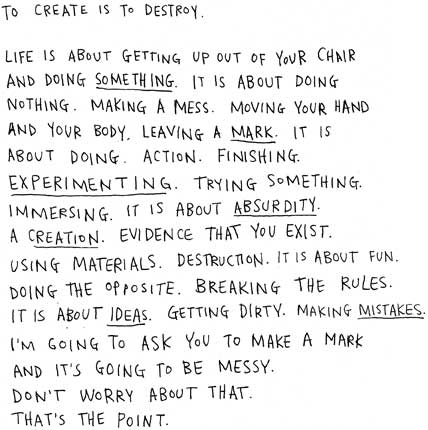
July: Wreck This Journal by Keri Smith


One of the recommended reads in this month's issue of readergirlz is the non-fic pick Wreck This Journal by Keri Smith. Many thanks to postergirl Miss Erin for bringing this cool, do-it-yourself book to our attention.

Wreck This Journal is exactly what the title implies: a journal you tear up, draw in, decorate, and create! I think The Plain Janes would be all over this book. Check out the awesome intro page as well as the Flickr group. Way to wreck a rec!

Want to win a free copy of Keri Smith's next book, How to Be an Explorer of the World? Simply leave a comment below with your email address. One winner will be selected at random on Tuesday, July 14th and notified via email that day.
Note: Entrants must be residents of the U.S. or Canada and have a valid email address.

Update: Thanks to all who entered. The contest is now closed. The winner is dreadfulpenny. Congratulations!