rgz

readergirlz is a literacy and social media project for teens, awarded the National Book Foundation's Innovations in Reading Prize. The rgz blog serves as a depot for news and YA reviews from industry professionals and teens. As volunteers return full force to their own YA writing, the organization continues to hold one initiative a year to impact teen literacy. All are welcome to "like" us on Facebook!

Showing posts with label hope. Show all posts

Wednesday, February 2, 2011

Math Doesn't Suck: Hopeful Numbers


The entire featured Math series by Danica McKellar is a huge boon for girls who thought they weren't good at math (how silly is that?).

Here are some hopeful stats from a Girls Inc. study that make it clear that girls rock the numbers:
  • Among SAT takers a higher percentage of young women than young men are enrolled in honors math courses (55% vs 45%).
  • Grade point averages in math and the natural sciences are higher for young women than for young men.
  • Women earn 47% of bachelor’s degrees in mathematics.
Aw, yeah! Any math-readergirlz out there?

Monday, January 31, 2011

Featured Series: MATH DOESN'T SUCK, by Danica McKellar

Happy Monday, readergirlz! Today, instead of a Featured Title, we've got a whole entire SERIES as our nonfiction pick for the month. And boy, do I wish these books had been around when I was in school.
It's no secret that historically, the perception was that math and science were "boy" subjects, while girls obviously gravitated to the social sciences and the arts. As a theory, it had, um, a few flaws. Sexist? Yep. Unfair? Sure. Self-fulfilling? Definitely. I can tell you from personal experience that after a few less-than-stellar experiences with math, I decided I was a hopeless case, and wrote it off. If only I'd had a role model to encourage me, and to push me to rethink my attitude toward math!

If only I'd had someone like Danica McKellar.
Here's what she has to say about her books, the MATH DOESN'T SUCK series, and her own experiences in school:


Let's get a few things straight: Acne sucks. Mean people suck. Finding out that your boyfriend kissed another girl? That would totally suck. Too much homework, broken promises, detention, divorce, insecurities: suck, suck, suck, suck, suck.
But math is actually a good thing. Here are a few reasons why: Math builds confidence, keeps you from getting ripped off, makes you better at adjusting cookie recipes, understanding sports scores, budgeting and planning parties and vacations, interpreting how good a sale really is, and spending your allowance. It makes you feel smart when you walk in a room, prepares you for better-paying jobs, and helps you to think more logically.
Most of all, working on math sharpens your brain, actually making you smarter in all areas. Intelligence is real, it's lasting, and no one can take it away from you. Ever.
And take it from me, nothing can take the place of the confidence that comes from developing your intelligence—not beauty, or fame, or anything else "superficial."


The MATH series is a perfect fit for this month's theme, as McKellar gives girls everywhere hope that with a little patience, we can conquer anything, even those school subjects that seem scary and overwhelming.
And it's no surprise that McKellar makes such a poised spokesperson; some of you may know her as the teen star of the tv show,"The Wonder Years." Check out this video, where she talks about her own experiences with math!
So, what do you think, readergirlz? If you've struggled with math like I have, does this series give you hope? Or, maybe you've always been a math whiz, but this book series has inspired you to tackle something else that always seemed complicated? What subjects are you hopeful about conquering this year in school?


Can't get enough of Danica McKellar? Check out her website and her Facebook page, and be sure to read up on her series, KISS MY MATH, and her latest release: Hot X: Algebra Exposed!


Wednesday, January 26, 2011

Because I Am Furniture: Writing in Verse

Our Featured Title this week is Because I Am Furniture by Thalia Chaltas, and in her post, Thalia describes "the frustratingly beautiful ache" of the puzzle of putting words in verse, poetic vignettes, together to tell a story.

Have you ever tried to write in verse or gotten lost a book of poems? Why is the format appealing? What about it makes it such an attractive way to express emotions?


Monday, January 24, 2011

Featured Title: BECAUSE I AM FURNITURE, by Thalia Chaltas

Hello, readergirlz, and welcome to another Monday Featured Title!
Some of you may know that I've recently taken a personal interest in writing in verse, so I'm extra-excited to be welcoming Thalia Chaltas to the blog today. Her verse novel, Because I Am Furniture, is lyrical, beautiful, and moving - a wonderful example of how strong, well-paced narrative can be woven from elegant poetry.
Anke’s father is abusive. But not to her. He attacks her brother and sister, but she’s just an invisible witness in a house of horrors, on the brink of disappearing altogether. Until she makes the volleyball team at school. At first just being exhausted after practice feels good, but as Anke becomes part of the team, her confidence builds. When she learns to yell “Mine!” to call a ball, she finds a voice she didn’t know existed. For the first time, Anke is seen and heard. Soon, she’s imagining a day that her voice will be loud enough to rescue everyone at home—including herself.

Her book is also a perfect pick for this month's theme, Hope. Don't believe me? Here's what Publishers Weekly had to say:
“Incendiary, devastating, yet—in total—offering empowerment and hope, Chaltas’s poems leave an indelible mark.” (starred review)


Wow! 
If you're wonder what it's like to craft a novel from poetic vignettes, you're in luck! Thalia has offered us a glimpse into her writing process: 


Writing a novel in verse is such a different animal than prose. It starts out similarly. I like being still and listening to a character’s voice and what she has to say. Then I hate the process of dumping it on the page - that first draft is always physically painful for me. These two steps are the same for me in verse and prose. But writing a novel in verse means the editing step is enormous, and I absolutely love that process.

In my novels, each poem in free verse is the main character’s experience, a short written out video clip of the character’s perspective. The “clips” are put in chronological order to show the story. The problem is, I don’t necessarily write them in chronological order; I write them as they come to me via the character. There is an amazing amount of moving poems around to see what fits where, a frustratingly beautiful ache of a puzzle.

Because of this, I have a sticky tab technique where each character has a different color. For each poem, I apply characters’ sticky tabs to the page if they are in the poem. Then I turn the manuscript edge-on, to see whether the characters are well dispersed throughout the novel – are the pink Yaicha tabs clumped together somewhere? Is there too much space between Jed’s appearances so we forget where he is at times? Do I need to write another poem?  This visual technique is helpful when moving poems around to create a better story line.

Thanks for having me, and good writing to you all!


Fascinating! I love the idea of having a visual cue to the progression of a story arc. Here's a shot of Thalia's tab system in action: 
In addition to being incredibly organized, I just think those bright colors look so pretty! I'll have to try out this technique with my next project, which will also probably incorporate some verse. 
So readers, what do you think of Thalia's process? And if you're someone who likes to write across different formats and genres, what are some of the ways that you make the transition from one to another? 

Monday, January 17, 2011

Featured Title: THE BEAUTIFUL BETWEEN, by Alyssa B. Sheinmel

Alyssa Sheinmel is the author of this week's Featured Title, The Beautiful Between, as well as the forthcoming The Lucky Kind, releasing this May. 


The eagle-eyed among you may recognize her last name - indeed, Alyssa is sister to Courtney Sheinmel, whose novel, Positively, was last week's featured title. Obviously, talent runs in the family - not to mention, the ability to craft an optimistic, hopeful message within a story that deals with serious themes.


Here's what School Library Journal has to say about The Beautiful Between

Connelly Sternin, 16, moves through her New York City high school on cruise control. She is an average student who doesn't get into trouble, doesn't sit with the cool kids, and has a quiet home life. She fantasizes that she is living in a fairy tale and sees herself as Rapunzel, confined in an Upper East Side tower amid college applications and SAT scores. She sees wealthy Jeremy Cole as the prince of their school: loved and respected by all. What she doesn't see coming is a friendship with him based on tragedy—his younger sister has leukemia—and secrets—Connelly is preoccupied with learning how her father died. Jeremy knows more about her life than she does, and together they find the fortitude to face the present and the past.


One of Alyssa's greatest skills is handling dark topics with a light touch - her protagonist balances introspection with humor, and Sheinmel's high school setting rings very true (even for those of us who've been out of high school for, um, some time now). I'm so glad that she's here today to talk with us about Hope!


I was honored to hear that The Beautiful Between had been selected as a Featured Title on readergirlz, but even more so when I learned that the theme for the month was Hope.  As I write this, it’s the holiday season, and hope seems to be on everyone’s mind.  Hope was certainly in my mind when I sat down to begin writing The Beautiful Between: hope that I would actually finish a book I had started writing; hope that the story would take shape, and take off; hope that it might be published; hope that it might find readers.  And, hope was in my mind as the story developed, because, despite the fact that The Beautiful Between deals with some fairly sad, if not downright depressing, themes – isolation, estrangement, death – I really believed that it was a hopeful story.  A story filled with the promise that although life may hand you painful things along the way, you can also find the grace to play – and win – with the cards you are dealt, good and bad.  So, I’m thrilled for The Beautiful Between to have been chosen by readergirlz, since hope is such a tremendous part of the story.


And I think that hope is a tremendous part of being a writer; at least, it certainly has been for me.  I think there’s hope in every sentence I write: hope that I will learn to say things better than I have before; hope that the story in my head will come across on the page, (or the screen, as the case may be).  And then there is the hope that writers place in their readers’ hands: hope that someone will read your book and understand what it is you wanted to say; hope that someone will read your book and like what it is you’ve said. 

And, for me, looking over what I’ve written, from the novels I’m working on now to the short stories I began writing when I was six-years-old, hope has been an over-arching theme in my writing.  I often place my characters in difficult circumstances, and I might beat them up a bit along the way.  But I think almost everything I’ve ever written has ended on a note of hope.  A note that perhaps, despite what my characters may have lost over the course of the story, they also gained something – a friend, a love, or maybe just an insight – that will make their lives infinitely better than they were when the story began.  Sometimes, I think the thing my characters gain the most by the end of a story is hope itself, and that allows me to leave them behind, to end the story, knowing that they might go on, better and more hopeful, than they were when I began.

One of the best pieces of writing advice I've received was "break your characters' hearts every day," so I completely agree with Alyssa - testing your characters with adversity allows them to grow stronger through the course of a story. And hopefully (pun intended), reading about characters finding hope in seemingly hopeless situations can help readers find their way to a more positive place in their own lives, as well. 

Thanks so much to Alyssa for joining us! Be sure to check out The Beautiful Between, and keep an eye out this spring for The Lucky Kind!


Thursday, January 13, 2011

Hope: Markéta Irglová's Speech at the Oscars

Markéta Irglová spoke of hope when she and Glen Hansard the Academy Award for Best Original Song for Falling Slowly, which I put on this month's playlist. Here's what she said:

"Hi everyone. I just want to thank you so much. This is such a big deal, not only for us, but for all other independent musicians and artists that spend most of their time struggling, and this, the fact that we're standing here tonight, the fact that we're able to hold this, it's just the proof that no matter how far out your dreams are, it's possible. And, you know, fair play to those who dare to dream and don’t give up. And this song was written from a perspective of hope, and hope at the end of the day connects us all, no matter how different we are. And so thank you so much who helped us on the way. Thank you." - Markéta Irglová

Isn't that lovely?

Now, consider this: Her initial acceptance speech had been cut off by a music cue! Glen gave his speech, but when Markéta walked up to the mic, the orchestra started to play, cutting her off. Thanks to host Jon Stewart, Markéta was able to come back on stage and have her moment. That is when she gave the speech as quoted above.

Click here to watch the award announcement and subsequent speeches.

Monday, January 10, 2011

Featured Title: POSITIVELY, by Courtney Sheinmel

I'm so excited to welcome Courtney Sheinmel to readergirlz today! I've seen her out and about at various NYC author functions but hadn't "met" her until her fantastic, moving, and oh-so-HOPEful book, Positively, was chosen as postergirlz pick this month. I loved it when I first read it, so I was glad to have the chance to tell her so in "person."


"Emmy is infected with the HIV virus, and her mother, infected before she married Emmy's father, dies of AIDS at the beginning of the book. Angry and alone, the 13-year-old moves in with her semi-estranged father and newly pregnant stepmother. At a loss for how to help Emmy recover from her grief and alienation, they send her to a summer camp for girls with HIV and AIDS. There she realizes that she is not alone, not the only person to take handfuls of pills on a daily basis, not the only girl who worries about the complications of dating with the virus. She returns home with a new perspective, welcoming her half sister into her life and admitting her newfound desire for a happier, more "positive" existence...  Emmy's situation is compelling and underrepresented in YA fiction." -- School Library Journal

Compelling is definitely the right word! Here's what Courtney has to say about hope:

Once when I was fifteen years old I was babysitting for three kids, two girls and a boy.  The boy had HIV, the virus that causes AIDS, and back then, in the early 1990s, that diagnosis was often a death sentence.  The conversation turned to what the kids wanted to be when they grew up.  The boy said he planned to be a baseball player.  I always had hopes his future, and at that moment I truly concentrated on it:  Please, PLEASE let him grow up.

Eighteen years have passed, and he’s a grown up now.  A few weeks ago I had lunch with another friend.  She’s a college freshman and she also happens to have HIV.  We were talking about what she wanted to do with her life.  I was throwing out suggestions and thinking, Oh, please, let her find her way.  Hours later I realized her being HIV-positive didn’t occur to me when we were talking about her future – not once, during the entire conversation.  There was just no doubt in my mind that she does have a future – a long and glorious one – ahead of her. 

And that’s the kind of thing that gives me hope, and makes me believe anything is possible.

Thank you so much, Courtney, for visiting with us, for shedding light on an issue that isn't often addressed in children's literature, and for your own irrepressibly positive outlook! 

What do you think, readergirlz: when you think of the future, what do you hope for - for yourself, and for others? 


Wednesday, January 5, 2011

The Chosen One: How Do You Generate Hope?

Our Featured Title this week is The Chosen One by Carol Lynch Williams, and in her post, she talked about how to generate more hope.

So tell us, readergirlz, how do you generate hope in your life? Name something that have given you hope in the last year. And let's get to spreading the HOPE!

PS-Don't forget to read our Cover Story on that lovely braided cover.

Tuesday, January 4, 2011

January Playlist

Hey readergirlz! Check out our playlist for this month's theme, Hope:


Get a playlist! Standalone player Get Ringtones

(If you can't see the playlist above, you need Flash.)

Note: Not all of the recommended songs were available at the Project Playlist website. Here's the full list of tracks:

Only Hope by Mandy Moore
Joy by David Poe
Moon River by Henry Mancini as performed by Audrey Hepburn
Your Song by Elton John
Hope For Me Yet by Marc Broussard
Save Yourself by Sense Field
Positivity by Ashley Tishdale
The Middle by Jimmy Eat World
Falling Slowly by The Frames (or Glen Hansard and Markéta Irglová, whichever recording you prefer!)

Monday, January 3, 2011

Featured Title: THE CHOSEN ONE, by Carol Lynch Williams

Hello readergirlz! Here's hoping that everyone had a relaxing holiday season and is feeling cheery and bright-eyed about the new year. No wonder January's theme, Hope, seems particularly relevant during a season of fresh starts, resolutions, and new beginnings.


I'm thrilled to kick off our January title features with Carol Lynch Williams' tense, gripping, and oh-my- goodness-yes, uplifting, The Chosen One. Carol is a fellow Vermont College alumn, and I've been one of her biggest fans since, oh, just about the moment I first met her.


Taking a story “ripped from the headlines,” Williams looks inside a polygamist cult and the dangers it poses for one girl. Kyra and her father, three mothers, and 20 siblings live in an isolated community under the thumb of a prophet, who controls every aspect of his apostles’ lives. The most shocking intrusion of all comes when the prophet decrees that Kyra is to become the wife of her 60-year-old uncle. A secret patron of a local mobile library, Kyra knows there’s a world away from the compound she might escape to, but first she pins her hopes on her father’s ability to change the prophet’s mind. Instead, her family is threatened, and the stakes for her refusal to marry are raised. Williams’ portrayals of the family are sharp, but what’s most interesting about this book is how the yearnings and fears of a character so far from what most YAs know will still seem familiar and close.--Booklist


I'm so excited to have Carol here with us today, talking about hope: 


What a lovely opportunity to have readergirlz think of my novel The Chosen One. It is such a nice honor. Thank you, Girls!


Hope and Things

It seems most of my life I hang on to hope by the tips of my fingers. Yes, I tend to be a little down, a little depressed. It’s a hard way to live.

But I do have hope in my life. My amazing editor for
The Chosen One is named Hope. When I start to leap off the deep end, she’s there to stop me or throw me a rope if I’ve already taken the plunge.

In my book
Glimpse, the main character is named Hope. She started out something else (I can’t remember what) but the name Hope kept pressing in on my brain. And the truth is, later I saw she was her sister’s hope. So it worked out for me as a writer.

And in
The Chosen One, Kyra, the main character, finds out what it’s like to have hope, lose hope and find the tendrils of belief again so she has something to hold on to.

Hope is something we all deserve. It shouldn’t be taken from us by bullies at home, at school or on the street. It’s a gift, like agency.

Just recently (after several very sad things that happened) I discovered something. I was wandering around feeling awfully hopeless. And I was doing quite a bit of whining (those two go hand in hand for me--hopelessness and whining). It just so happened that while the sad stuff was going on, I had started a new novel about grief. That means I was whining, writing and wandering about (the 3 Ws). I couldn’t get away from the grief. I kept asking “Why?” (Another W word!)

And that’s when it came to me. It was kind of like a slow burn--I had this bit of an idea that unwrapped itself slowly and left me with something I felt--even in my saddened state--I could live with. It was how to generate more hope.

I realized something you all probably know: that hope for other people might be influenced by me. We can actually help someone feel better. When we’re a friend, when we’re kind, when we look to the welfare of others (and I don’t mean financially)--we make a difference. We create hope. We create change.

What happened after that was a subtle shift inside of me. When I looked away from my sorrow and offered hope to others, I felt better. All the pain hasn’t gone away, but I started feeling a  bit of comfort.

Hope means we care for others and then it’s like we get a gift all for ourselves--and the world gets that much better. Just because of a choice. A decision.

This is my biggest discovery this year: Life isn't fair and it never will be--but we as good people can make it easier. And that’s what I set out to do in 2011. I hope you join me.


Carol Lynch Williams is the author of more than 20 books for middle grade and young adult readers including Pretty Like Us, The Chosen One and Glimpse. Her newest novel comes out in March 2011 and is called Miles from Ordinary.  Carol has an MFA from Vermont College but the best parts of her life are her five beautiful daughters. Visit Carol at www.throwingupwords.wordpress.com where she shares a blog with Ann Dee Ellis, Ally Condie, and her daughter Kyra Leigh.


What a beautiful post, Carol! Thanks so much for joining us. I do find that when I'm feeling my most hopeless or down, it's invigorating to try to reach out to others - not in the expectation that they will comfort me, necessarily, but that by giving of myself to someone else, I'm reminded of my own value, and putting good karma out into the world. What a wonderful message on which to embark upon a new year!

So readers - how do you find hope in seemingly hopeless situations? 


Friday, May 21, 2010

Guest Blog: Melina Marchetta

Like our May book pick, Absolutely Maybe by Lisa Yee, the novel Looking for Alibrandi by Melina Marchetta explores the relationship between a long-absent father and his teenaged daughter. For this and many other reasons, the postergirlz named Looking for Alibrandi a recommended read for the month of May. After I informed Melina of this, we discussed this month's theme, hope. Here's what she had to say:

A couple of years ago a blogger wrote a one sentence review of my novel, On the Jellicoe Road. It was bleak indeed. Death, suicide, teen pregnancy, abandonment, depression and the list went on and on. It was pretty awful to see your work reduced to a list of bleakness. What I wanted her to mention was the hope. That it was a story about redemption, love, community, identity, humour and friendship.

Hope is what I try to offer in all my work. In Alibrandi, despite the losses Josie faces in the end, she refuses to be a pessimist because she believes in the goodness of the individual person. In Francesca, on the last page Frankie Spinelli goes to school with hope in her heart regardless of the uncertainty in her life. In Jellicoe, Taylor Markham ends up in a house by the river that was built to bring solace. In Finnikin the two main protagonists may have a different view of homeland, but they both journey thousands of miles to bring a sense of place to a dispirited people. In The Piper's Son, I used a simple gesture between three generations of men to convey that perhaps Tom Mackee and his family and friends are going to be okay.

Ending a story with hope isn’t easy. Not because there's not enough around, but because it can come across clichéd or super sweet or as if you're saying that life has a simple solution. But I try anyway because I would never leave the reader without a safe place to go. That's not to say that I believe it has to be the prerequisite for all storytelling, but I've made it the number one rule in mine.

~ Melina Marchetta

Wednesday, April 29, 2009

Hope: Shelf Elf

When I was thinking about our "hope" theme this month, for some reason, those lines from that famous Emily Dickinson poem kept coming to mind: Hope is the thing with feathers / That perches in the soul.* I love that whole poem because it captures so much of what hope is for me. Hope can be fragile and impermanent, but it is often stronger than it looks. Sometimes it appears when you need it most, and when you’ve almost forgotten what it is, like a bird in the springtime. What makes me hopeful? Poetry. Lucky pennies. Random acts of kindness.

- Shelf Elf

* Read Emily Dickinson's poem in its entirety.

View all posts labeled with hope.

Monday, April 27, 2009

Hope: Emily Wing Smith

For me, hope is an unexplained bubble of excitement in my chest that won't burst -- despite the reasons it should! Sometimes that mysterious bubble is the only thing keeping me going as a writer.

As for what makes me hopeful: Warm chocolate chip cookies. Any warm chocolate dessert, really. To me, as long as the human race has the ability to make delicious baked goods, things are bound to look up. I have great faith in chocolate.

-- Emily Wing Smith

View all posts labeled with hope.

Read one of my favorite passages from Emily's novel, The Way He Lived.

Thursday, April 23, 2009

Hope: Courtney Sheinmel

Thank you, Little Willow, for asking me to describe what "hope" means to me.

I've been struggling to put it into words. Life is such a strange, unpredictable, and often difficult thing – there's a lot to be scared of and of course there's great sadness. It seems like a natural response to just be depressed and want to give up. But hope is the antidote to that. It's the reason to live, the ability to look forward, to expect a lot and believe things will work out. I have always had an elaborate fantasy life. My friends have made fun of me when I've described, often in great detail, my winning the lottery, accepting the Newbery Award, or being invited backstage at a Madonna concert. When you hope, you are setting yourself up for disappointment; but hope is continuing to have faith in your wildest dreams.

My book, Positively, is about a thirteen-year-old girl named Emmy who is HIV-positive and who lost her mother to AIDS. I know it's a really sad story, but I think it's mainly about hope – losing hope, and finding it again.

- Courtney Sheinmel

View all posts labeled with hope.

Tuesday, April 21, 2009

Hope: Holly Cupala

I think of hope as a little piece of eternity that lodges itself in us, orientating us toward what is to come, what can become - exactly the opposite of blame. Blame looks to the past. Hope looks to the future. Loss and hardship can seem meaningless, if we're looking for reasons in the past. Sometimes they are in the future, and we haven’t discovered them yet. They may open doors that would otherwise be sealed. I've found this to be a theme in my writing as well as in my life.

- Holly Cupala

View all posts labeled with hope.

Wednesday, April 15, 2009

Hope: Elizabeth Scott

What's your definition of hope?

Something we all want, and something that can be hard to find and hold on to. It's joyful possibility, and when it comes it may only be for a moment -- but sometimes, a moment is all you need.

What makes you hopeful?

When people believe in themselves. Love. The stars on a clear night, when it looks like you can see forever.

- Elizabeth Scott

View all posts labeled with hope.

Check out Melissa's Cover Stories post about Living Dead Girl by Elizabeth Scott.

You may read my full-length interview with Elizabeth as well as my reviews of her fantastic books at my blog Bildungsroman.

Sunday, April 12, 2009

Hope: Lorie Ann Grover

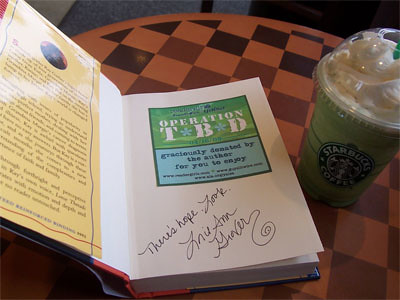
I always sign my copies of Loose Threads with a line from the book: "There's hope. Look." It's a truth that I hold most dear. I do rest in sovereignty and believe in providence. Those beliefs maintain hope in my heart and mind no matter how dire the circumstances. I've lived through dark experiences, yet there's always light deep within. I may not see it in the moment, but my work is to keep looking for it and grasping through the shadows.

I think of my novels as whispers into the ears of readers. "There's hope. Look."

- Lorie Ann Grover

Lorie Ann Grover's Hope


View all posts labeled with hope.

Thursday, April 9, 2009

Hope: Melissa Walker

To me, hope is the surge of positive feelings that lead to real, glorious action.

- Melissa Walker

View all posts labeled with hope.

Tuesday, April 7, 2009

Hope: Daphne Grab

What's your definition of "hope?"

I think of hope as belief in good, as seeing the potential for the positive to prevail even in the face of great challenge. Hope can be a joyous fountain when something good happens: a cute guy asks you out, you get into the college of your choice or you, you know, sell a book. Then you get to look at the future as this place with a golden glow. That kind of hope is a glorious feeling.

Hope is a much more tenuous thing to hold onto in dark times. In my book Alive and Well in Prague, New York, the main character's dad has a terminal illness and is slowly losing his body to a disease. That is the kind of situation where it's the hardest to feel hope, because the future is set and it looks pretty barren.

But then that is the beauty of hope, that it can still be there, under the darkness. That's what my main character finds, much as I found when my own dad was terminally ill. Hope lies in the little moments, in being able to perform old rituals, have deeper conversations and find the preciousness in each moment you do have. Hope is in believing you can survive something that is crushing and still hold onto goodness in your life. And hope is the thing that makes those things survivable.

- Daphne Grab

View all posts labeled with hope.

Hope Posts

Hope. I try to fill myself with hope every single day, along with wonder, determination, and other important things.

In honor of this month's theme, Hope, I'm going to publish a series of posts in which I ask various people:

What's your definition of "hope?"
What makes you hopeful?


I'll be posting their answers at both my blog, Bildungsroman, and right here at the readergirlz blog.

I'm kicking off the series with Daphne Grab, author of Alive and Well in Prague, New York, one of this month's recommended reads.

Bookmark this post or follow this tag and check back throughout the month for more interviews of hope.