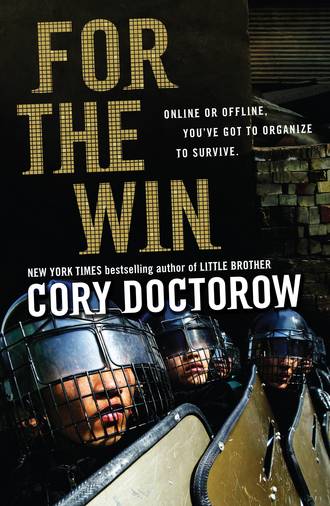
Hello, readergirlz! As I mentioned on Monday, for our first Featured Title of the month, we're mixing things up a bit (it's been a week of big rgz announcements, so why not?)! Cory Doctorow's For the Win is our first selection on the theme of Risk-taking, and on Monday, we asked what you think is risky about writing for teens. One comment that came up was the tendency of the "adult" publishing world to sideline or de-legitimize the genre.
(Side note: I mean, really?)

Here's what Booklist had to say about For the Win:
Doctorow is indispensable. It’s hard to imagine any other author taking on youth and technology with such passion, intelligence, and understanding. Set in the near future and in locations across the globe, the story involves a sweeping cast of characters making a living in such virtual-game worlds as Svartalfheim Warriors and Zombie Mecha. Many of them endure physical threats from their bosses to farm virtual gold, which is then sold to rich First World gamers. Then these brilliant teens are brought together by the mysterious Big Sister Nor, who has a plan to unionize and bring these virtual worlds—and real-world sweatshops, too—to a screeching halt. Once again Doctorow has taken denigrated youth behavior (this time, gaming) and recast it into something heroic.
Cory has asked that we share with you this excellent article originally written for Locus magazine, where he reflects on his own commitment to writing for teens, and the ways in which a risky genre - and the risky, emotion-charged behavior of teens themselves - make for an appealing literary landscape to any reader or writer. Here's an excerpt:
Writing for young people is really exciting. As one YA writer told me, "Adolescence is a series of brave, irreversible decisions." One day, you're someone who's never told a lie of consequence; the next day you have, and you can never go back. One day, you're someone who's never done anything noble for a friend, the next day you have, and you can never go back. Is it any wonder that young people experience a camaraderie as intense as combat-buddies? Is it any wonder that the parts of our brain that govern risk-assessment don't fully develop until adulthood? Who would take such brave chances, such existential risks, if she or he had a fully functional risk-assessment system?
So young people live in a world characterized by intense drama, by choices wise and foolish and always brave. This is a book-plotter's dream. Once you realize that your characters are living in this state of heightened consequence, every plot-point acquires moment and import that keeps the pages turning.
We couldn't agree more! We urge you to check out the complete article over at Locus. And in the meantime, we want to know - what are some of the risks you've taken (as a teen or otherwise), and in what way/s did that risky choice enable you to grow?